












































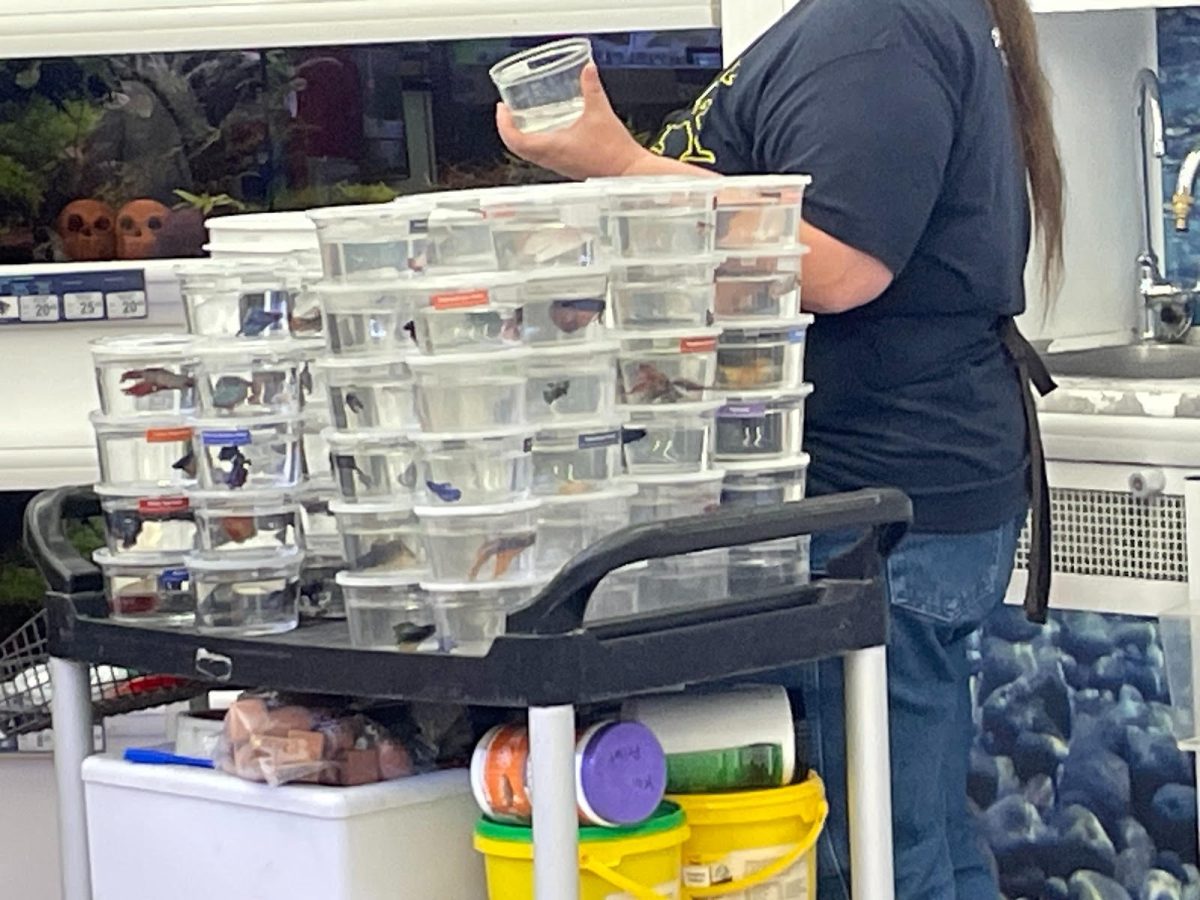
A new shipment of bettas after arrival at a Petco finally getting a water change, while dozens from the last shipment are still on shelves nearby. Photo courtesy of senior Leila Milton.
San Luis Obispo High School has a lot of animal-loving students, many of whom have their own pets. However, like so many other pet owners, they don’t always know how to properly care for them.
Animals are delicate, and even small mistakes can lead to pets getting sick, hurt, or even killed. It can be very difficult to find the right information to prevent those mistakes, and that problem is intentional.
“[There were] things I knew nothing about and had to learn later just how wrong the pet stores were. I actually found a lot of people said not to listen to what [the pet stores] said,” said senior and bird owner Selene Ramirez.
Like any other industry, the pet industry is driven by profit. Although some companies strive to treat animals well, other companies will prioritize profit over the well-being of animals, and this leads to many unethical and immoral practices. In order to avoid losing their animal-loving customers, these companies hide what they are doing.
They leave out information that doesn’t fit their narrative, and will even provide misleading or straight-up inaccurate facts and statements that make the company seem as though they really are prioritizing pets over profit. When so many companies promote misinformation, it becomes difficult to find out the truth, and sometimes even well-meaning educational sources will get their information from these lies.
Being aware of the deception in the pet industry and learning where to find real information is an important first step to being well-informed when making decisions for pets.
“[When I did research about pets] I looked for people who constantly went to certain animal conventions and would clearly look like they had experience in caring for the animal species I was learning about. I would hear a lot more information that you wouldn’t get at a pet store. Unfortunately, I’ve also met people who would be taking care of their animals with only the instructions of the pet stores, and helped explain that it was a great start, but there was just so much more to it. Listening to people who actually have experience is a really good source,” said Ramirez.
There are so many different aspects of taking care of a pet, and all of them are susceptible to altered information.
“When I think of misinformation, I think of pet stores mostly, spreading false information about the needs of the animal, whether it be cage size, food type, or veterinary needs,” said senior Madison Ruggerone.
Some of the most mistreated animals in the pet industry include hermit crabs and betta fish. There is a lot to be said about them both.
Terrestrial hermit crabs are often available in pet stores, but it is very rare for those stores to disclose just how difficult it is to care for the hermit crabs. Additionally, land hermit crabs almost never breed in captivity. So, to fulfill the pet industry demand, the hermit crabs are caught in the wild, crammed into shipping containers, and shipped to pet stores. Many of them don’t even survive long enough to get to the pet store, and those that do survive are often sick or injured.
Betta fish in pet stores are not caught in the wild, but they still have to endure terrible conditions. Bettas breed quite easily, and most bettas at chain pet stores are imported all the way from Southeast Asia. Chain stores will often import more bettas than they can sell before the next shipment. Some have been known to import even three times more bettas than the store’s maximum capacity, stressing out the employees who are trying to care for them.
But why? Profit, of course!
There is a huge demand for bettas, because many pet stores advertise them as being a very easy pet to keep. Many parents get betta fish as pets for young children to teach them about responsibility. Although it is true that bettas are easier to care for than many other pets, they still need more than most people realize.
Bettas are one of the most intelligent pet freshwater fish, and need room to explore. They also produce a lot of waste (known as bioload), and this can quickly make the water unhealthy. Experienced betta owners recommend a minimum tank size of five gallons to keep the water healthy and the betta happy.
And yet, many tanks that are marketed as being specifically for bettas are much smaller: a quick search of the Petsmart website shows “betta tanks” that are only one gallon!
Bettas also need to have a heater for their tank, set to around 78 – 80 degrees Fahrenheit. Without this, the betta will become sick. They also need a filter and routine water changes to keep the tank clean.
These needs are very different from what bettas get when they are in tiny cups at pet stores.
While animals marketed as “easy pets” are the victims of a lot of mistreatment, even notoriously high-maintenance popular pets can face similar problems. Dogs are a perfect example of this.
“[I worry about misinformation concerning] health facts, dog food, and medicine. I want accurate information on the flea medication that my dogs have,” said English teacher and dog owner Scott Nairne.
Students at SLOHS also notice these problems.
“I definitely see [dangerous misinformation] with dog treats, which is a big problem. Most people will just go and buy either the cheap Dollar Tree treats or they would get stuff based off of the packaging. What I realized was a bunch of these name brand, popular pet treats used in a lot of harsh chemicals or just didn’t fit the kind of dietary needs a pet should have,” said Ruggerone.
Even pet toys can be dangerous!
“There are certain bird toys like mirrors or ones with certain fabric I wouldn’t buy because of the risk of danger,” said Ramirez. “Some people have different ideas about if mirror toys are ok for birds in different situations, and in my experience my birds often got caught because of their claws in certain fabrics, so I would personally stay away from them.”
When doing research on things related to pets, it’s always a good idea to speak with other people who have more experience. By asking many people, it will be easier to have an understanding of what works and what doesn’t. Sometimes you can even learn important information from pet store employees, as they might be very knowledgeable about a species that they personally own.
“If I have questions about medication and food, I’d ask Lemos. I do my research by going to actual stores and vets that I trust,” said Nairne.
There are many people who don’t realize how prevalent misinformation and mistreatment is in the pet industry, and to them, it may seem like there isn’t a big issue. It’s hard to recognize if something is wrong when you don’t know a lot about it. But even if something doesn’t seem like an issue at first glance, there is a lot more than meets the eye.
A well-hidden problem will only get worse if it is unseen or simply ignored. By noticing and calling attention to the unethical secrets of the pet industry, changes can be made, and dangerous mistakes can be prevented.
Do as much research as possible before getting a pet or making a change to their care. By getting pets and pet supplies from ethical, honest places, and encouraging others to do so, you will be keeping your pets safe and help to drive the industry in a better direction.