























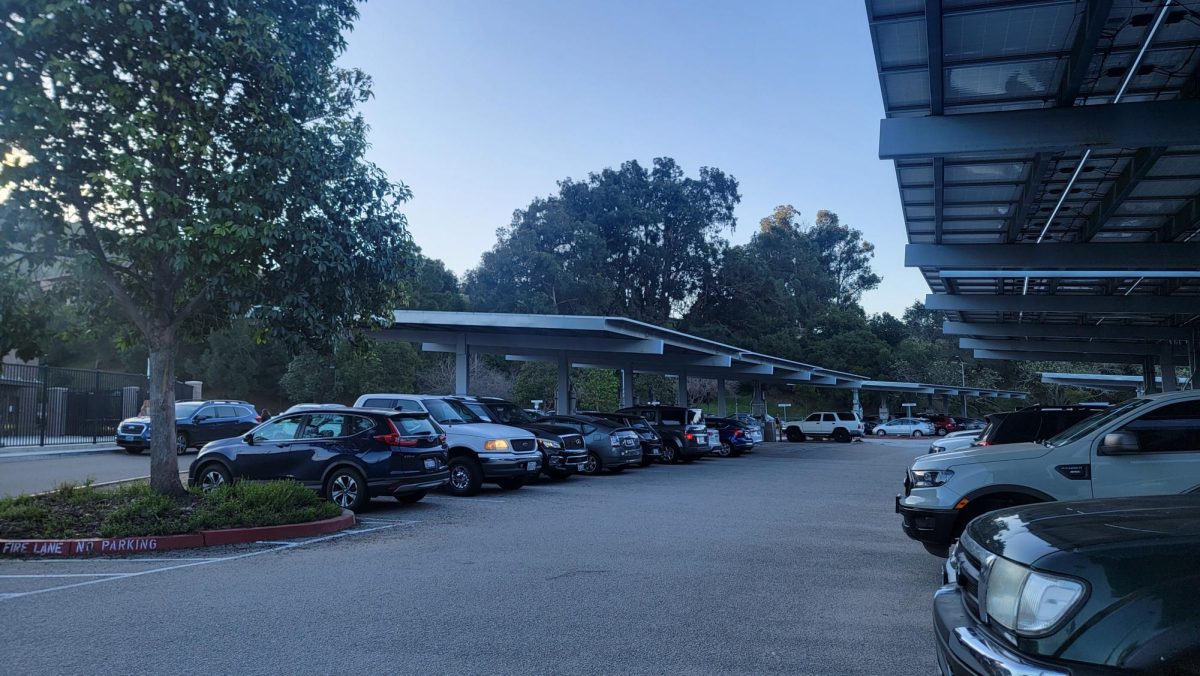
The San Luis Obispo High School parking lot is filling up at the beginning of a morning rush. Photo courtesy of senior Aidan Field.
San Luis Obispo High School has been plagued by bad drivers. A walk through the parking lot today is just another chance to get hit and land up in the hospital with sprained joints and broken bones. Student behavior, like illegal drug use and vandalism can get a student kicked from sports teams and other school events, but students can drive like maniacs whenever they want.
It’s time to build better driving habits, SLOHS needs to enforce safer driving.
“I drive my car to school, but I normally park around two blocks from the school due to traffic and fear of someone hitting my car,” said junior Will Woffinden.
Car accidents aren’t rare for teenagers. Over this past school year at least three students have been hit by cars on their way to school while riding bikes. Fender benders are also becoming more common.
“I got hit in the parking lot a few weeks ago… I think it’s probably because they’re allegedly a terrible driver and they’ve hit multiple people before,” said an anonymous senior.
Throughout the school year, sophomores and others are getting their licenses, meaning that the parking lot is becoming increasingly more crowded and dangerous.
“My issues are that it’s unsafe for bikers, cars, and pedestrians… It’s not always students getting into accidents, but I’ve seen it all. I think the weirdest one was when somebody put their car in reverse to make room for somebody else, and then ran into somebody that was behind them. It’s just the people with all that traffic, they start to panic and then they stop thinking,” said math teacher Blake Bristol.
In the United States, eight teenagers die every day in a car accident. Hundreds more are injured. Accidents involving teens also amount to $40.7 billion in medical costs and lives lost in 2020 alone.
The toll of risky driving for teens shouldn’t be understated. When accidents and reckless driving happen on our campus, students shouldn’t just be holding each other accountable.
“I don’t think [students] understand all of the ramifications of the decisions they make,” said Bristol.
Student behavior is already regulated on campus by security and administration. If a student is shoving people in the halls of our school, they’re immediately talked to and that behavior is corrected.
Why is this different for behavior when students are at the helms of thousand pound machines?
Dangerous behavior, like drug possession, is harshly disciplined by the district and our administration, but it feels like behavior around driving isn’t talked about enough.
When administration talks to students about school policies, education on safe driving, especially within school property, shouldn’t be pushed to the sidelines. Specific behaviors such as texting while driving, which might be advised against in freshman year health, get forgotten and become less fresh in students’ minds as they become drivers.
“Seeing students be on their phones and driving seems like such an extremely stupid thing to do, especially considering the ratio between risk and reward,” said Woffinden.
It’s also important to note that SLOHS does encourage safe driving. On nearly all weekly newsletters, members of our school community are encouraged to drive safely. The law is also usually upheld because of local police presence.
Issues inside the parking lot also aren’t fully behavioral, and teen drivers might always be a more reckless demographic. Some argue that issues are because of infrastructure, not purely student behavior.
“If you go to any high school, there’s teenage drivers, parents are picking up their kids, so we’re not unique in any way. Our traffic is a lot worse than a lot of places because of how narrow the area is. Having only one lane in both directions, without streetlights at both ends. It just creates a bottleneck,” said Bristol.
Bristol proposes adding additional exit and entrance lances, controlled traffic lights, and potentially making San Luis Drive a one way street. Just one of these ideas has the potential to relieve stress and accidents.
The solution to bad driving on campus is a combination between driving habits and issues stemming from the school parking lot’s design. Fixing these problems likely also requires better awareness of dangerous driving habits.
SLOHS can start encouraging safer driving in specific lessons, announcements, and reminders. Extending administrator presence in the school parking lot might also encourage students to be conscientious drivers, and eventually help them build better habits.
It’s probably also time to get the traffic lights San Luis Drive is lacking.
Sources: cdc.gov