

























The logo of one of the biggest leeches in the thrift store market: Thrifty Beaches. Photo from thriftybeachslo.com.
Thrifting is dead.
Its mutilated body lies strewn in the streets of fashion. The students of San Luis Obispo High School try propping it up on a stick and pretending it still exists, that it’s still alive. But it is not. And its killer runs rampant, wearing the skin of thrifting on their face, a horrible grotesque monster.
Of course, I am talking about Thrifty Beaches.
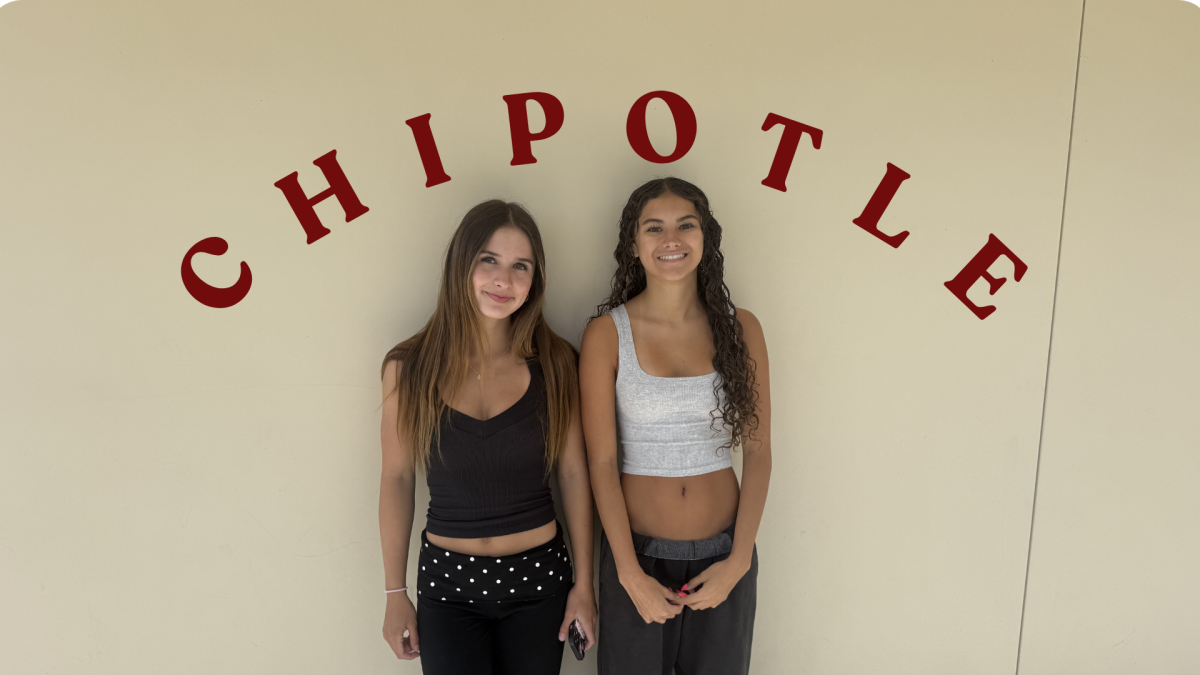
“Thrifty Beaches buys up clothes and jacks up the price! It’s just clothes, I shouldn’t have to sell an arm and a leg just to buy a leather jacket.” said senior Avery Sheffield.
Thrifty Beaches is a San Luis Obispo originated “thrift” store that opened September 14, 2024 to massive success, as students of SLOHS and the general population alike flocked to the store to take place in the trendy fad which is “thrifting”, the act of buying used clothing or other goods instead of new ones. However, this trend has become less about finding cheap and practical clothes, and more of a status indicator or wealth and fashion sense, as they often charge anywhere between one hundred and two hundred dollars for a voguish pair of pants or coat.
“Thrift stores should be affordable,” said senior Charly Elston, “Thrifty Beaches really contributes to the culture of commercialized thrifting, like rich people ‘thrifting’: not to help the environment or to save money, but just because it’s cool. Don’t get me wrong, everyone should be purchasing second hand goods for clothes, furniture, etc…but that brings in predatory business practices that capitalize on the trendiness of thrifting and try to charge more for products.”
Throwing hyperbole aside, there is a general vibe that I feel is associated with thrift stores. When I think of thrift stores, I think of small, slightly cramped stores that sell used junk and trinkets that may not be as high quality as brand new items, but they’re cheaper and more accessible. What I do not think of is a large department store with way more room than it needs, selling used clothes at ridiculously marked up prices with no perceivable quality increase from a similar, newer, cheaper item.
“I’ve found stains on their clothes and that’s crazy to find with prices like theirs,” said Elston.
However, some people defend the store, arguing that the store sells “vintage” clothing that’s of a higher quality than typical thrift stores.
“Vintage clothes are just more well known brands from back then, as well as more sought after pieces that people would be willing to wear,” said freshman Lucas Reinhart. “I feel like with real thrifting as an experience, it’s harder to find pieces like that. You’re more likely to find pieces that anyone would wear, instead of specific clothes from, let’s say the 2000s or 2010s.”
Even while defending the store, Reinhart agrees that Thrifty Beaches is not a thrift store, rather this other genre of “Vintage” store.
“I love Thrifty Beaches, but I’m 52 years old and willing to pay more for a cool vintage Patagonia jacket or a belt. Maybe old people like me are the target audience?” said English teacher and SLOHS Expressions adviser Scott Nairne.
So why are they trying to commercialize on the thrifting market with their name and advertising, undercutting real thrift stores that provide you quality clothes.
“I think Fred and Betty’s, and even Goodwill are great places to find clothes. You just have to be creative,” said Sheffield, “Thrifty Beaches is just for people without a good fashion sense that are told that that’s what they should pay good money for.”
Tigers, let us wake up from this horrible nightmare of commercial thrifting culture, and realize that overly-expensive, middling quality clothing is not our only option when it comes to thrifting.
If you’re status seeking and looking for “vintage” accessories that flaunt your wealth and perceived cultural supremacy, Thrifty Beaches might be for you, but the alternative of affordable used clothes at smaller thrift stores, Goodwills, or even neighborhood yard sales are great ways of keeping clothes in the community without spending a small fortune.
Sylas Grove • Oct 14, 2025 at 4:18 pm
That one chatgpt comment lmao. Anywho I think people are taking a high schooler being mad that a thrift store is too expensive way too seriously. The real issue is people going to goodwill and other thrift stores and either stealing or sniping pieces to resell for an insane price when underprivileged families rely on those establishments.
Adam Kemp • Oct 13, 2025 at 9:15 pm
If you look on Google or the Thrifty Beaches website, it clearly says Vintage everywhere. Nowhere does it say thrift store. The names of most businesses have little to do with what they actually are, so judging my business based solely on the name—and calling that journalism—is, frankly, strange.
At the very least, some research could’ve been done on one of the fastest-growing industries in the world: reselling. I actually started this business while I was a student at Cal Poly.
I was motivated after visiting donation-based thrift stores and seeing the incredible things people were giving away for free, simply because they shared your mentality—that used items aren’t worth anything. Many older individuals believe their belongings have no value, but that’s far from true. Taking their items for nothing and reselling them for a large profit never felt right to me.
If you’re frustrated that it’s harder to find great pieces at thrift stores these days, you should actually be happy for the people who are finally getting paid for their items instead of donating them for free. If that’s what you mean by us “killing thrifting,” then I guess you’re right—we’re changing it by valuing the people behind the clothes.
It’s also strange that traditional thrift stores are raising their prices even though they still receive everything for free.
You asked about our curation process—I’d refer you to our website. We have a detailed buying guide posted there. I’m sure you looked at it before writing that article.
Adam Kemp • Oct 13, 2025 at 8:54 pm
“Thrifty” is an adjective—it describes a person who uses their money wisely and does not spend wastefully. We advertise ourselves as a vintage store. Thrift stores receive donations; we, on the other hand, advertise that we buy daily. We have $10 bins and $5 bins, and thousands of items priced at $10 or less.
Saying that we have jackets priced over $100 doesn’t mean we’re overcharging—some things in life are simply more expensive. This article would’ve been more credible if you had actually identified which items we’re supposedly overcharging for. You could have gone into our store, selected a few higher-priced items, and compared them to their market value in the resale community. The argument doesn’t make sense because being unable to afford something does not mean the establishment is overcharging.
We work hard to source the best clothing possible, and we price most items below market value. The vast majority of businesses fail within their first two years. If we were truly overcharging, the market would correct us—people wouldn’t buy. Yet we continue to grow and expand. In fact, we occupy more retail square footage in San Luis Obispo than any business besides Target and Costco.
If customers are purchasing items at our prices, you can hold the opinion that we charge too much—but the market itself is proving that opinion wrong. About 70% of the clothing we sell consists of garments made in the USA. If we were going out of business, that might support your argument—but we’re not; we’re expanding.
Our prices are fair compared to other stores in our industry. People have literally driven across the country—over 30 hours—to sell us their clothing because we pay strong rates for used garments. We believe people shouldn’t have to give away clothes they paid good money for; those items still have value. If we’re paying people fairly for their clothes, it’s only logical that we sell them at reasonable resale prices.
Your dramatic introduction didn’t make much sense. Our mission is to encourage clothing reuse—and we’re accomplishing that. Just because something is used or stained doesn’t mean it lacks value. I recently purchased a pair of jeans for $30,000 and even did a $150,000–$250,000 coin flip for another pair from the 1890s—completely thrashed and stained.
It’s perfectly fine to admit when you’re inexperienced in the world of vintage clothing. But vintage is not about perfection—it’s about history, rarity, and craftsmanship. That’s what we stand for.
Bob • Oct 14, 2025 at 11:34 am
Hey Adam. This is a fair argument. I suppose I just see an issue with the alleged status attached with something old that makes it “vintage”. A lot of your buying guide just lists that you buy old things and insert value into them by calling them “vintage”. I think your point about charging $150,000 for a pair of pants exemplifies this: there is no practical use for these pants. It’s purely a status symbol to own this; because the pants are old, despite being dirty and destroyed, they are “quality”.
Significantly, I feel like you underplay the importance of a business name. The name of a business is their brand: it is where there marketing comes from. Oreos are not just sandwich cookies, they are Oreos. Target is not just a department store, it’s target. If your name has “thrifty” in it, people will associate it with a thrift store. Regardless of what the denotative meaning of “thrifty” is, the connotative meaning is quite apparent and I would expect you to understand this, as I suspect you do.
-Bob
Anthony • Oct 13, 2025 at 11:34 am
First off, interesting article and insightful for a high schooler, but I have to challenge you. I get why people care about protecting traditional thrifting, but calling Thrifty Beaches “the death of thrifting” misses how this industry really works.
California has about 1,800 resale and consignment shops, the most in the country, and many of those are for-profit curated boutiques—not nonprofits like Goodwill or Salvation Army. In Oakland there are more than 40 curated vintage stores, and in Los Angeles over 100. Shops like Wasteland, Aralda Vintage, and Mercy Vintage have followed this model for decades. It’s not new or exploitative; it’s simply another lane within the resale world.
Thrifty Beaches does what many successful California stores do: buy or consign quality vintage, curate it, and resell it at fair retail prices. That’s no different than a used bike shop charging for expertise, space, and upkeep.
They also employ local staff, bring consistent foot traffic to downtown SLO, and support hundreds of independent sellers who earn income by providing inventory. In a time when so many small businesses are closing, we should be supporting the ones that create jobs and keep money circulating locally.
Love the initiative, and you’re coming from a good place, but in the context of the overall market, I think this article missed the mark.
Bob • Oct 13, 2025 at 6:14 pm
Hi Anthony. I really do think this is a fair comment. I think perhaps my issue in that case would be in them labeling themselves as a thrift store when they’re clearly something else. You seem to label the difference between the two industries to be the “curation” of the items, and that within the curation holds the extra value that justifies Thrifty Beaches pricing.
My question for you, then would be, what exactly goes into this curation? I’ve heard many reports from customers, including one quoted in my article, that they go into the store and find the “curated” clothing to be stained or otherwise damaged.
This is a genuine question, I will admit that I’m uninformed on the curation process. It seems from what you and Mr. Kemp are saying is that Thrifty Beaches purchases most of their clothes from local sellers, and perhaps by knowing the qualifications one has to pass in order to sell their clothes, we could know the curation process. If you know anyone who has done this, I will gladly ask them!
-Bob
Anthony Roberts • Oct 14, 2025 at 4:00 pm
Bob, I don’t see a “reply” feature on here, so ill paste yours below. Again just wanted to say, I’m impressed by the way you’re handling the comments! Wouldn’t know I was speaking to a high schooler.
Full disclosure, I’m adams brother in law, and as you can see we are a close family and take pride in thrifty beaches, so we were surprised by your article! Want to address your comments below:
Naming it a thrift store – You know, that’s fair, but i don’t know what else he could name it and still bring attention to the store! Adam has mentioned “Thriftique”.
What goes into curation? – Wow. I think this is where the disconnect is! You should honestly come and see one day. I don’t work for TB, but when I tell you it is SO MUCH WORK. They go through the piles by hand, lookup the prices that they sell for, and sell them for about 1/4 of that price. They re-donate a ton of stuff. There’s just alot to it. Adam’s a super nice guy, if you wanted to come to the store and see for a day, I bet he’d be happy to.
Stains and rips – You’d be amazed at how much those stains or rips INCREASES value/ demand. He prices things accordingly when they have stains or rips, or even puts them into the $5/ $10 bins.
I think your paper was interesting, and I like the opinion, but maybe it would be helpful to reach out to someone for comment next time? You may come away with the same opinion, but in this case I think it would open up your eyes to the side of it you don’t see. The amount of work/ thought that goes into the curation is amazing (not to mention the amount of money he loses because he may make a mistake, buy something for too much, or something simply doesn’t sell).
In summary, I think if you came and understood the business model, it may change your opinion. Keep up the great work kid.
————————————————————————-
B
Bob • Oct 13, 2025 at 6:14 pm
Hi Anthony. I really do think this is a fair comment. I think perhaps my issue in that case would be in them labeling themselves as a thrift store when they’re clearly something else. You seem to label the difference between the two industries to be the “curation” of the items, and that within the curation holds the extra value that justifies Thrifty Beaches pricing.
My question for you, then would be, what exactly goes into this curation? I’ve heard many reports from customers, including one quoted in my article, that they go into the store and find the “curated” clothing to be stained or otherwise damaged.
This is a genuine question, I will admit that I’m uninformed on the curation process. It seems from what you and Mr. Kemp are saying is that Thrifty Beaches purchases most of their clothes from local sellers, and perhaps by knowing the qualifications one has to pass in order to sell their clothes, we could know the curation process. If you know anyone who has done this, I will gladly ask them!
-Bob
Leroy Kemp • Oct 13, 2025 at 11:12 am
Calling Thrifty Beaches a “leech” on thrifting isn’t journalism—it’s resentment dressed up as opinion. The truth is simple: Thrifty Beaches is a positive economic and cultural force in San Luis Obispo, and the community has already voted on that—literally.
⸻
1. Thrifty Beaches puts money back into the community.
Unlike Goodwill and other donation-based thrift chains that receive free inventory, Thrifty Beaches pays people cash for their clothing. That means real money going to students, families, and locals. That’s not a leech—that’s local economic circulation and respect for people’s goods.
⸻
2. Pricing isn’t “predatory”—it’s the reality of curated vintage.
This opinion piece confuses donation-based thrift with curated vintage retail—two completely different markets. Vintage Carhartt, Patagonia, Levi’s selvedge, Nike ACG, Harley Davidson—these are historic, high-quality garments that last decades. They aren’t pulled from donation bins—they’re sourced, restored, curated, and authenticated.
Curation takes work. Work has value. Value determines price. Complaining about that is complaining about the concept of business itself.
⸻
3. The community has already spoken.
The writer claims Thrifty Beaches is “undercutting real thrift stores” and “hurting the community.” Really? Then explain this:
✅ Thrifty Beaches won “Best Thrift Store” in the 2025 SLO Readers’ Choice Awards (Best of SLO County) — voted by the public.
✅ The store has lines around the block during drops.
✅ Local families, students, and professionals shop there weekly.
You don’t get voted #1 in the county if people don’t support you—you earn that by delivering value.
⸻
4. Let’s talk hypocrisy.
Goodwill—the hero of the article—made over $6 billion last year while paying executives millions and workers near minimum wage. Meanwhile, Thrifty Beaches is a local independent business built from hustle—not donations. They hire locally, pay locally, and grow locally.
So who’s really the leech?
⸻
5. Thrifty Beaches is sustainable fashion done right.
Every piece sold is recycled clothing saved from landfills. That’s not “killing” thrifting—it’s expanding sustainable fashion and proving style doesn’t need to hurt the planet.
⸻
Final Thought
If someone wants $3 T-shirts, Goodwill is still there. Shop wherever you want—that’s freedom. But attacking a young business for building something successful through creativity, hard work, and sustainability? That’s not economic justice—that’s anti-entrepreneurial jealousy.
Thrifty Beaches isn’t ruining thrifting.
They’re redefining it—and clearly winning.
Bob • Oct 13, 2025 at 6:40 pm
Hey Leroy. Thank you for your comment. I think your argument brings up a lot of good points. For instance, I was uninformed about the inequitable distribution of Goodwill’s revenue, although I wish you were a bit less vague on the benefit of a business built from “hustle”, and elaborated more on what is so harmful about donation-based cheap reselling.
I think the reason my article might have confused thrifting from vintage curation is due to the name of the store. “Thrifty Beaches” insinuates a thrift store in my eyes, but I can understand that the store’s purpose may lie a bit more into curation. I expanded a bit more upon this in a separate article, but if you could inform me what goes into this curation process, I would be very grateful.
The main point I want to address in your article is how you attributed the store’s quality to the award it won. Now, while I think it definitely highlights a certain popularity the store attracts, I don’t think it in of itself justifies the pricing what I still see to be overly-expensive resold clothing. Thrifty Beaches is located downtown on one of the busiest streets in the city, as well as having truly impeccable advertising campaigns. The chances are, people who voted in this 2025 SLO Readers’ Choice Awards were likely not thrift store experts. It’s very possible they did not know there were stores with higher quality items that were sold for less and simply voted for a store they thought was the best of the ones that they knew; a very limited selection.
Furthermore, the 2025 SLO Readers’ Choice Awards was an optional poll sent out to readers of the New Times local paper. This creates two statistical biases, undercoverage and response bias, which both show that the result of the data does not necessarily accurately portray the opinion of the population of San Luis Obispo citizens. First off, the poll was only available to New Times readers, limiting the results of the poll to a very specific strata of SLO residents, one that may have other similar characteristics that don’t accurately portray SLO residents as a whole. Secondly, the poll was optional, meaning only people with strong opinions would respond; people who had no strong opinion are not represented in the award’s data. I think it’s fair to assume there are not many people like me that have such a problem with Thrifty Beaches that they would go out of their way to vote against them in a New Times poll, nor are there any other thrift stores in the area with big enough popularity or personal draw to pull mass amounts of votes. Furthermore, as discussed in the previous paragraph, even the people who did feel strongly about the store wouldn’t necessarily be impartial judges of the “best” quality of thrift store, they would only know what they’ve experienced. This isn’t to say that the award is meaningless, it’s only to say that using the award as a justification for the quality of the store itself is logically fallacious.
Finally, I hope to get a bit of clarification on something. You say here that all the clothes resold would otherwise be thrown in the landfill, yet Adam Kemp (who I am sure bears no familial relation to yourself) says that Thrifty Beaches purchases clothing that would have been put back into the community for free, and Antony comments that Thrifty Beaches consigns quality vintage clothing, which seems to be very different from clothes that are ready to be tossed in the trash. I do think this is probably just a wording difference between you and the other comments, but for my sake, I am curious what the process truly is for obtaining “every piece” of clothing sold.
-Bob
Mercedes • Oct 13, 2025 at 9:49 am
Wow so much anger in this piece about a store that is literally keeping SLO alive. ThriftyBeaches is where fashion is headed. Your in high school so you don’t understand. Before making accusations why don’t you interview the owners or employees, that’s what a real journalist does, they fact-check before they post a article that spreads false Information. Good luck in your career.
Bob • Oct 13, 2025 at 6:47 pm
Hey Mercedes, could you elaborate on how Thrifty Beaches “literally” keeps SLO alive? Or on why fashion is headed toward a specific local thrift store? Or, most importantly, what specifically is in my article that is factually false? While most of this article is merely my opinion, I don’t want to report anything that’s lie, so I’d appreciate if you could tell me what’s false information in my article.
-Bob
Jay • Oct 13, 2025 at 12:39 am
Smells like a bunch of haters wrote this llmmaaaooo
Maria • Oct 12, 2025 at 11:11 pm
The store may be called Thrifty Beaches, but it is pretty commonly known that it is a Vintage store. Yes of course if you are looking for a $3 t shirt go to a goodwill or achievement house, but to be outraged that a heavily curated vintage store with rare items and designer goods is “expensive” is like being upset that a Ferrari cost more than a Toyota. Same type of product but there’s a large difference in quality. Also Thrift stores do not purchase their inventory, they get it for free. Thrifty Beaches pays locals to get rid of those items, it’s a mutually beneficial experience.
Adam Kemp • Oct 12, 2025 at 11:11 pm
The majority of clothing that Thrifty beaches buys is clothing that people would otherwise give away for free. We have paid out over a million to the people of SLO county and surrounding cities. We have sold over 500,000 garments. We employ 32 students some of which go to slo high. There’s been a lot of local high schools asking us for monetary donations. Hmm weird how that works. Tearing down a local small business is weird journalism but whatever floats your boat BoB
Bob Meyers • Oct 13, 2025 at 6:04 pm
Hi Adam, thank you for your comment. I think I don’t understand what your argument is saying. The fact that you’ve sold over 500,000 garments seems to miss the point: just because you’re popular doesn’t mean you’re charging a fair or accurately valued price, which is the main problem I have with your store. Furthermore, you say you employ students, but so do most businesses downtown. If you’re paying them above minimum wage, that’s commendable, but it seems unrealistic to pay above a market price for labor when you don’t need to, so I would be surprised if you do. Finally, I think your first comment highlights my issue I have the most. You say Thrifty Beaches buys clothes that otherwise would be given away for free. …exactly. You advertise these clothes as “vintage”, meaning they must be high quality, and then charge more for them then they would cost without your intervention. If I misunderstood any of your arguments, I do apologize, but I feel I am entitled to express my opinions about your business, just as you are entitled to criticize my article.
-Bob