







































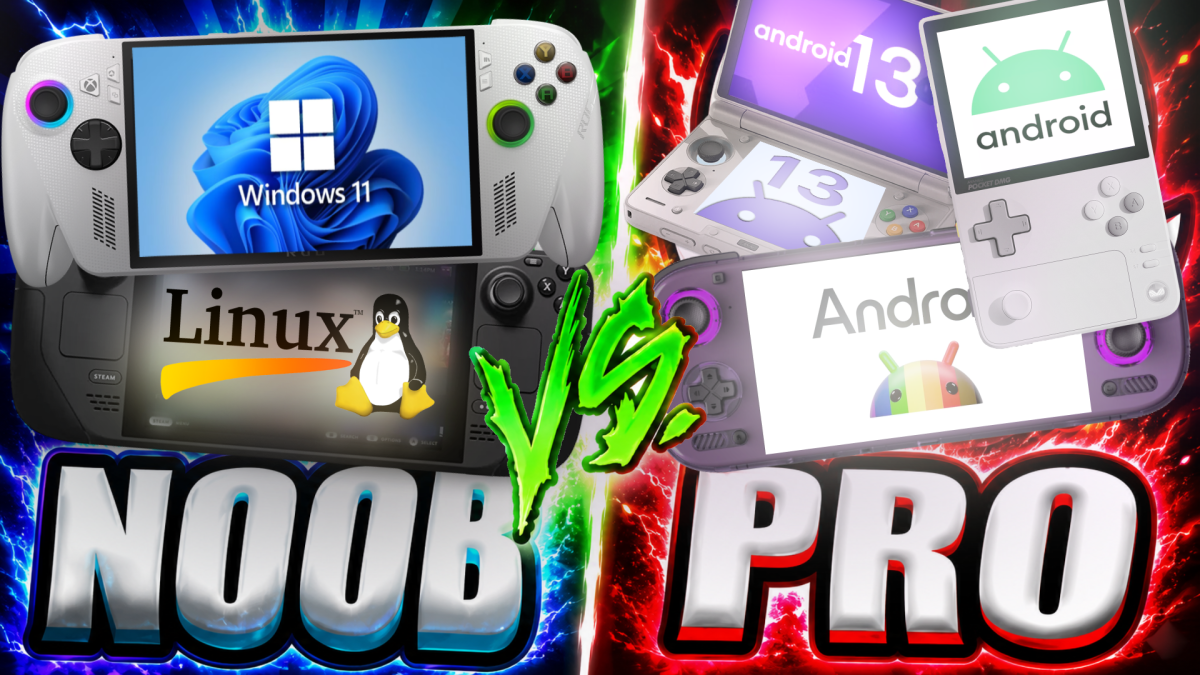
While Android gaming handhelds hold many advantages such as pricing and size over their PC counterparts, they also come with equally as many downsides. Photo illustration courtesy of junior Sawyer Cram.
With the debut of the Steam Deck in early 2022, San Luis Obispo High School and the mainstream gaming world was introduced to the concept of a portable gaming personal computer (PC). The Steam Deck was the beginning of an era of PC gaming handhelds that would go on to include the likes of the ROG Ally, Lenovo Legion Go, and MSI claw. While unique in their own ways, almost all PC gaming handhelds shared similarities in their large sizes and costs. However, a new line of handheld Android gaming devices that employ phone technology and parts rather than PC equivalents have the potential to overthrow the era of the PC gaming handheld.
Android gaming devices are much smaller and less expensive than their PC equivalents due to their utilization of high end smartphone processors such as Qualcomm’s line of Snapdragon chips. These processors are known as Systems-on-a-Chip (SOC) because they integrate many essential components into a single chip. SOC’s allow android gaming devices to take up much less space and be much more cost effective.
“Some of the issues that annoy me with the Steam Deck are that not all the games that are on the Steam store can be played on the Steam Deck, and require you to configure your own controls to make some games work. Android devices have their advantages like their smaller and lower cost but them not being as powerful or having the power to run a lot of triple-A games makes them less attractive to me,” said junior Ethan Ortega.
While they can offer many advantages over their PC counterparts, Android gaming handhelds have many shortcomings that have contributed to their lack of presence in the mainstream gaming market. While PC gaming handhelds such as the Steam Deck offer a near plug-and-play experience without any setup, android gaming handhelds often require extensive amounts of setup and configuration before you can begin using them for their intended purpose. The lack of a straightforward setup process can easily alienate a significant portion of the android gaming handheld market.
“While PC gaming handhelds attempt to have the same versatility as a full desktop, trying to cram the hardware and cooling needs into a handheld package is a difficult task, and usually comes with a lot of drawbacks. Android is a strong contender for its emulation abilities, making it easy to play older games on more convenient hardware. While it is much more difficult to get the full gaming experience on an android handheld It can still be achieved,” said sophomore Archer Ackerman.
Another caveat of the Android gaming handheld industry is the focus on emulation rather than natively running games. Game emulation is the act of using software that mimics the behaviors of game consoles such as the Game Cube or Nintendo Switch allowing you to run games that would otherwise be locked to their respective systems. Android gaming handheld devices are almost always oriented towards emulation rather than natively running games.
The reliance of emulation on Android devices can be another turn off for many people debating between Android or PC handheld devices. Emulation, especially of higher end systems such as Nintendo Switch, can require complex per-game configuration and an understanding of how different settings will affect games. Additionally, emulation requires the user to have backed up copies of the games that they wish to emulate. These files can either be obtained though modding your console to backup the files, or by sailing the seven seas—both of which come with their own risks.
“I would always choose a PC handheld, the plug and play aspect is definitely one factor. While the convenience of Android devices certainly offer upsides such as mobile playable games, and the lack of a clean setup and extra hurdles make it so I would choose a PC handheld instead,” said junior Dean Ray.
Ultimately, the benefits of Android gaming handhelds are not worth the additional trouble for the majority of people. As time continues to pass on, it should be expected that the gap between Android and PC gaming handheld devices will shrink, but only time will tell if the PC gaming handheld industry will be surpassed.
Source: steampowered.com