










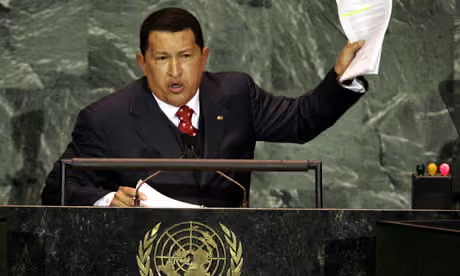
Former Venezuelan president Hugo Chavez speaks to the United Nations in 2005 where he scrutinizes US imperialism and the hypocrisy of American “freedom”. Photo courtesy of Timothy A. Clary, The Guardian.
Over the course of the last century, the United States has installed individuals that supported American interests to rule Venezuela four separate times, with the most recent one sparking widespread controversy. This forces San Luis Obispo High School students to ask, how far is too far when it comes to protecting the stability of the US economy?
With the United States’ recent military extraction of the Venezuelan president, politicians and social media influencers alike are sharing their very broad spectrum of opinions, leaving SLOHS students confused on what is real, what is biased, and what is moral. Often, recognizing historical patterns is an individual’s most reliable tool in making sense of times like these, and when it comes to the relationship between the US and Venezuela, there is an abundance of those historical patterns.
“The US definitely has a lot of history of the tribune, especially in Latin America and the Asian countries, but I guess seeing it happening this year, it’s kind of sad for me to see it. You would think that nowadays we’re past the age of imperialism, but the US is still active in enforcing what it means. The US still believes that it should be the one narrating rather than the people,” said senior Aidan Field. “If you go back to the founding documents of the US, it’s the determination that each country should be able to have sovereignty over itself and make their own decisions in regards to the government and foreign relations. So, it’s just contradictory to see that the US is actively engaging in imperialism even though it was founded on those principles.”
To fully understand the motive of these interventions, they must be examined from the beginning. Cipriano Castro was a newspaper manager who took up arms as a soldier against the Venezuelan Government after escaping from his six-month imprisonment, for which he was subjected for his participation as an independence advocate against the new Venezuelan government. When they failed their attempted coup, he fled to Colombia and hid for seven years, where he amassed a large military force, this time under his own command. In 1899, he marched on Caracas, succeeding in overthrowing the previous Venezuelan Government and establishing himself as military dictator.
Castro was antagonistic toward foreign powers, and after repeatedly refusing to pay his debts to Europe, Venezuela was blockaded by a fleet of European warships. As he began to develop serious medical issues, Castro was taken to get treatment out of the country. His second in command, Juan Gomez, backed by US Navy assets, took this opportunity to seize control of Venezuela.
Gomez’s policies were in many ways opposite to Castro’s. He settled disputes with foreign powers and welcomed American oil companies with open arms. Though Castro was cruel when it came to maintaining control, Gomez was much worse, known for torturing his opposition and hanging prisoners in the streets to set an example, not to mention he was very corrupt, siphoning his nation’s wealth into his own pocket by the millions.
Not only did US officials know about this, but they continued to support his regime, as long as he kept the oil flowing in.
“[Gomez is an] instrument of foreign control of the Venezuelan economy, the ally and servant of powerful outside interests,” said Romulo Betancourt (who ruled Venezuela about a half century later) in a political essay he wrote while in exile.
Eventually, Gomez’s reign ended, and people who held the nation’s well-being in higher regard took control of the country. Naturally, they charged American companies much higher fares for drilling their oil in order to pay for their citizens’ needs. During and following the Second World War, the US served as the supplier of resources for the Allies, leaving their oil reserves depleted, which was rarely a good sign for the people of Venezuela.
In 1948, the US backed Marcos Jimenez and installed him as dictator, knowing he would be immensely generous to American companies. Like Gomez, he did not hesitate to brutally oppress his people through murder, torture, and imprisonment in order to maintain control, and also like Gomez, the US government didn’t care, awarding him the Legion of Merit “for exceptionally meritorious conduct in the performance of outstanding services and achievements”.
Things got better when Venezuela became a democracy in 1958, but it was not until the election of Hugo Chavez in 1998 that this democracy significantly threatened American oil.
In a series of reforms known as the Bolivarian revolution (named after the revolutionary Simon Bolivar who died over 150 years prior) Chavez nationalized many important parts of the country. This resulted in a rapid decrease in poverty and crime, while greatly increasing the level of education, making him a popular figure not only in his own country, but not to governments across the world. Because the new Bolivarian Government demanded a fairer trade relationship with the US, George W. Bush and his administration, in a bold continuation of his predecessors’ trend, sought a way to re-secure American interests.
The US government labeled Chavez’s wildly successful social policies as “Marxist” and justified their support for a coup against Chavez as “combating communism”. The coup succeeded in ousting Chavez, but he had so much support from the people that he was restored as the leader of the country within forty-eight hours. Despite Bush’s continued effort to undermine him in the public eye, he remained in power. Even Bush’s successor, Barack Obama, continued to slander him in the media, calling him “authoritarian”, despite his fair election and high standing.
“A country isn’t justified to interfere in foreign politics just because it benefits them. Even if it benefits the economy, that doesn’t make it acceptable. There are times when it becomes necessary for America to take matters into its own hands, but hijacking a legitimate democracy is something our government should not be permitted to do,” said junior Brendan Forester.
The current (now ex) leader of Venezuela, Nicolas Maduro, known for his brutality and oppressiveness, was replaced by yet another Venezuelan politician who is particularly friendly to American companies. Despite many Venezuelans being liberated, these recent events are similar to past ones on a level impossible to ignore.
“When imperialism feels weak, it resorts to brute force. The attacks on Venezuela are a sign of weakness, ideological weakness,” said President Hugo Chavez in a speech at the World Social Forum in 2005.
If US meddling in the Venezuelan government has never been for a reason other than oil, what makes this time any different? This is a question that people all over the country, though specifically SLOHS students, are asking themselves. However, the true nature of the most recent incursion will not become fully clear until its repercussions have fully resonated.
Sources: theguardian.com, britannica.com, pomona.edu, venezuelanalysis.com