










































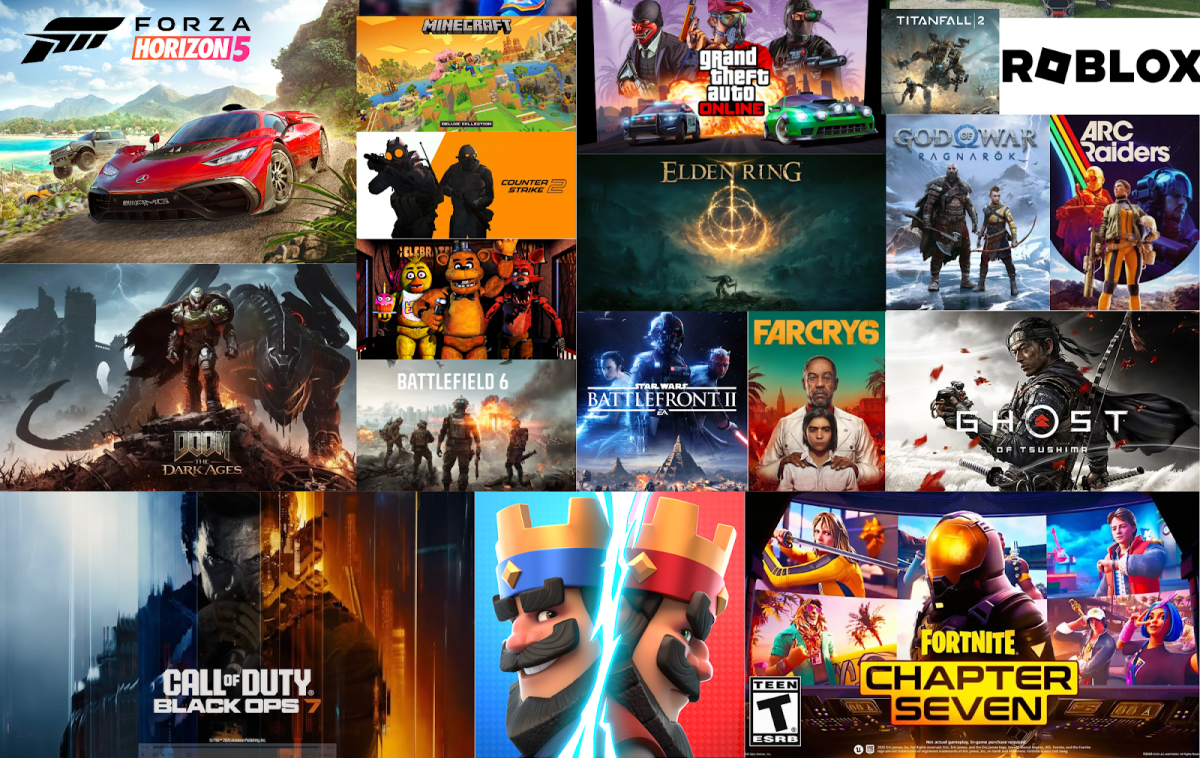
Current favorites at San Luis Obispo High School, students can’t get enough of these games. Photo collage courtesy of senior Alan Rodarte.
Gaming has had a big impact on San Luis Obispo High School students’ lives by helping connect with others, and has seen a much bigger impact during the COVID-19 pandemic when teens were locked inside their homes. Teens resort to social media and video games to connect with others. Has it experienced a decline in popularity or overall user interaction since then?
“I think a person who got me into gaming was my older cousin. When ‘Black Ops 2’ came out, he was always playing that game. I always wanted to play that game, so he then motivated me to buy my first PlayStation 3, which I liked to grind ‘Mortal Kombat 9’ on,” said junior Eric Ozuna.
Video games have helped out with a lot of things, but they’re in danger of declining if game developers don’t start to listen to their fan base. For example, “Fortnite,” once a titan in the battle royale scene, has seen a massive decline in players as it started reusing collaborations like Marvel and “Star Wars” too frequently, and not listening to fans’ concerns about aspects of the game.
For example, when they brought back skins that players could only obtain if they started in the first season of the game. Many players who have been with the game from its inception to the present have shared their opinions, as they were unsatisfied with the decision to bring back skins considered OG, leading to older supporters who were there at the game’s beginning to leave.
“I would say, like not having constant updates, and like carrying back or giving back to the community, and like what they want more, so you’re just doing too much rather than what the fans actually like,” said senior Juan Carlos Martinon.
Something that has affected gaming in general is the argument that microtransactions hurt the game more than they seem to benefit its longevity. People argue that games involve a pay-to-win model that gives some users with money an advantage. But some games, although most have moved away from crate-openings, have caused teen and even younger players to gamble for skins or weapons, sometimes wasting a huge sum of money.
“I feel like at some point they’re negative towards games, as not everyone’s trying to spend that much money on a game, and it kind of ruins the fun, because it makes everything about money,” said senior Adrian Hernandez Perez.
Game devs can prevent the decline/drop in users of an industry, with a “global value for 2023 was $184 billion, with over 3.2 billion gamers worldwide,” said Video Games Deputy Andres Lahiguera from the International Trade Administration.
With lower pay-to-win purchases and hearing their fanbase when they see the game at the beginning of a decline, they can save their game and not destroy their studio and industry, by losing billions of dollars, and GDP for the country they have built the game out of.
With the surge in price of how much RAM (Random Access Memory) costs, gaming might see a decline in the ability for new players to actually play, as RAM is not being made as frequently as HBM (High Bandwidth Memory), used for AI servers to improve bandwidth while decreasing energy consumption. The three big RAM companies are SK hynix, Samsung, and Micron. Have decided to spot DDR5 RAM as the best form of RAM to install in most gaming rigs, like consoles or gaming PCs. DDR5 32 GB RAM has gone up from around $100-$150 before 2025, and now, entering 2026, DDR5 32 GB RAM costs around $300-$1000 for RAM that is on shelves right now. With most AI datacenters reserving RAM, the price is expected to stay the same till 2030. With this, the new PS or Xbox console can see an increase in retail price. The current Xbox Series X goes for $650, whereas the original launch day price was $500.
“I think people are not able to afford a console. It’s gonna hurt gaming, because consoles are supposed to be the cheaper option; it’s gonna make the number of people who play games decrease over time. It would hurt it just because a lot of people don’t take it really seriously, and they don’t want to build a PC,” said senior Adrian Hernandez Perez.
With gaming peaking on June 16, 2025, and still showing a possible rise, but is an expected and unexpected decline expected sometime soon, given the craze over RAM pricing, microtransactions filling most games, and developers not delivering what fans want? Many players will start to notice this lazy, lackluster output from devs. Companies will also see a decrease in sales for RAM as the price continues to get higher, promoting a decline in gaming.
Gamers at SLOHS are maybe considering these growing problems as games start to feel bland and gaming is getting more expensive to play. With these reasons, some students here at SLOHS might move further from gaming.
Sources: trade.gov, windowscentral