






































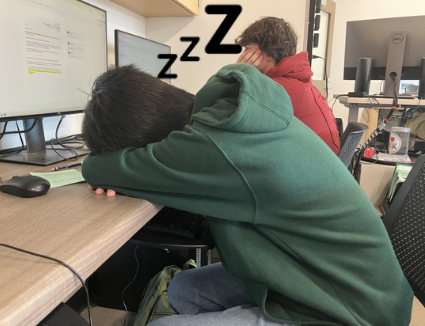
Freshman Jonathan Gies took a nap in class instead of listening to Nairne. Photo courtesy of freshman Herschel Joyce.
San Luis Obispo High School students have to deal with tons of stressful things every hour of the day. There are educational aspects like tests, grades, and homework, as well as social stuff like friendships, rumors and more.
When all of this adds up, students can be getting less sleep than usual, which is why schools should provide a thirty minute nap time during the school day! Students could do whatever they want, as long as it’s calm and relaxing.
“I think a benefit of nap time is that we get to have sleep so we can work harder in our classes,” said freshman Will Damschroder.
There are many ways nap time can benefit students, especially with mental health. All the things students have to deal with can add up, and be really bad for mental health, which can have a huge impact on lives in and outside of school.
“I do not believe a dedicated ‘nap time’ during school hours would be beneficial for all students. The reality is that a nap time period would only benefit a small number of students. What would all of the other students who chose not to nap do? Unfortunately, state law requires time in the classroom to be educational. It would be tough to provide students who chose not to nap extra classwork during that time,” said health teacher Daniel Monroe.
Having a short nap time during the day could really help students relax and help get rid of some of the stress caused by activities from school and sports. Even if students don’t sleep, it could be a time to relax or talk with friends (quietly). Some people think that instead of nap time, school could start later in the day.
“I think school should start at 10:00,” said freshman Jack Haring.
Currently, the school day starts at 8:30 a.m., which is an improvement from when it used to start at 8:00 a.m., but for many it’s still too early.
A University of Delaware study found that napping can help teenagers with neurocognitive functioning tasks. The study was performed in China where mid-day napping is culturally acceptable. The study found that a thirty to sixty minute nap was able to invigorate students, but was not too long as to affect their circadian rhythms. The study also found that habitual nappers slept better at night.
Overall there are many benefits to having extra sleep, so it would definitely be a good idea for schools to have a nap time during the school day. Talk to your administrators today about this scientifically founded idea.
Source: k12dive.com