





































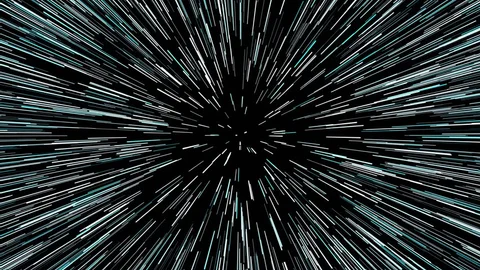
Remember when Luke and Hans Solo used “Hyperspace” travel from the famous George Lucas film “Star Wars?” Image courtesy of Shutterstock.
Science fiction media and literature often feature characters traveling from a planet in one star system to a planet in another in a manner of hours. Earth’s closest star system, Alpha Centauri, is 4.37 light years away, or about forty trillion kilometers, and would take over one hundred thousand years to reach with current technology.
Some rocket propulsion specialists believe that this journey could be shortened to twenty thousand years by redesigning spacecraft to prioritize speed. Even light itself takes over four years.
So, if light doesn’t even come close to sci-fi velocities, then how do they do it? Well, it’s actually simpler than you might think.
There are two primary concepts for FTL (faster than light) travel. The first utilizes a plane that is parallel yet much more compact than normal space. For example, let’s say this plane is 1000 times smaller than space. You enter at one point, travel two hundred kilometers, then exit, and you will be two hundred thousand kilometers away from where you started. A device like this was popularized by George Lucas’ Star Wars, however his “Hyperspace”, rather than a 1000:1 ratio was more like 2100000000:1 ratio. For reference, If you slapped a Hyperdrive from “Star Wars” on the Artemis II rocket, it would take only thirty minutes to reach Alpha Centauri.
So what is stopping us from building a Hyperdrive? For one, a more compact plane of space has not yet been discovered, in fact the idea that something like that could exist is merely a theory. Even if we did discover one, the technology required to move between space and said plane is something we are yet to even theorize.
The second concept for FTL travel is one that holds more merit amongst theoretical physicists. Matter cannot move faster than the speed of light, but space itself is not matter, and therefore has no such law. In 1994, Mexican physicist Miguel Alcubierre proposed a device that could create a bubble around a spacecraft and warped the space outside of that bubble at FTL speeds, a bubble which he called a “warp bubble”. This was inspired by “warp drive” from Gene Roddenberry’s “Star Trek,” a fictional, though theoretically possible method of propulsion.
However, even the Alcubierre Drive has its issues. Aside from the unimportant ones such as lethal levels of Hawking radiation or the ship being obliterated upon arrival due to particle and energy buildup outside the warp bubble, the device would require immense amounts of energy and may violate causality.
Some physicists project an Alcubierre drive would require more energy than every star in the known universe combined. Theoretical forms of matter, known as “exotic matter” could be used to reduce the energy requirement by combining the spacecraft with the exotic matter’s negative mass, potentially decreasing the net amount of mass within the warp bubble. However, we are far from even producing any form of exotic matter, much less harnessing its effects, so dubbing it a solution to the energy problem is generous at best.
These are things known as “engineering problems”, things that could prevent an Alcubierre drive from being built or used in practice, but not something that forbids its use entirely.
“The galaxy is such a big place. If you want to show that, sci-fi writers have to use faster than light speeds to convey the scale of those distances,” said an anonymous junior. “The amount our technology has developed is exponentially greater than what the people of the past had thought. So, I think just because we can’t imagine traveling the galaxy faster than light doesn’t mean it isn’t possible.
The final issue is far from an engineering problem and applies to all forms of FTL travel, possibly tearing the threads that hold the fabric of space-time together.
For example, say a ship leaves Earth’s orbit and travels faster than the speed of light toward a planet in Alpha Centauri. An Alpha Centaurion (something one might call an inhabitant of Alpha Centauri) is looking at the ship orbiting earth through a very powerful telescope. Because the image of the ship leaving Earth’s orbit travels at the speed of light, the ship would reach Alpha Centauri before the image of its departure did. But this is just a matter of perspective.
Objectively, the ship didn’t actually arrive before it left…right? Well, according to Einstein’s Theory of Relativity, causation itself travels at the speed of light, meaning it isn’t just what the centurion observed, the ship truly had arrived before it left. The laws of causality are clear on this matter; Cause must precede effect. Many physicists argue that the laws of the universe do not allow paradoxes such as this one to occur, and that that alone prohibits FTL travel.
Does this mean FTL travel is impossible? Not necessarily. A ship, whether in Hyperspace or in a Warp Bubble, is not actually moving faster than light when compared to their immediate surroundings, even if it would seem that they are to an observer in normal space.
So the question is, can FTL travel using something like an Alcubierre drive lead to causality violations? The answer is that there is simply no way to be sure with our current knowledge, but that won’t stop physicists from theorizing about it for years to come.
Sources: iflscience.com, harvard.edu, andersoninstitute.com, watamu.edu